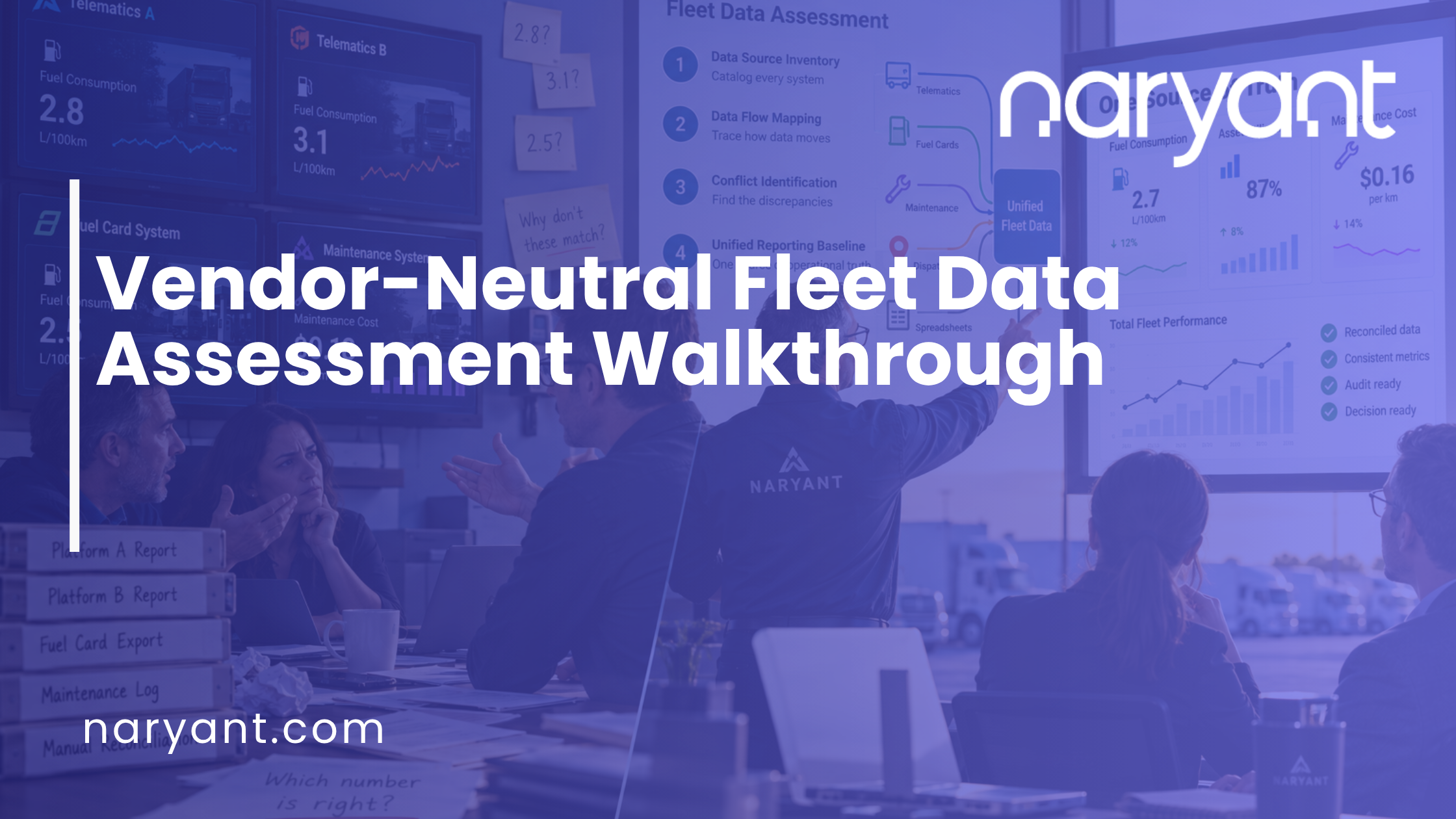
Your fleet runs three platforms. Each one tells a different story about fuel consumption, utilization, and maintenance costs. The morning meeting turns into a debate about which number to trust, and the quarterly review becomes an exercise in manual reconciliation instead of strategic planning. This is what a Decision Collision looks like, and it is one of the most expensive problems nobody is measuring.
According to Fleet Advantage's 2026 survey, 71% of fleet operators cite data integration challenges as a barrier to AI adoption, up from 38% just one year earlier. Trucking Dive reports that 66% of fleets identify interpreting or acting on telematics data as their single biggest challenge. The data is there. The problem is that nobody independent has walked through it.
A vendor-neutral fleet data assessment is an independent, structured review of a fleet's entire data environment (every telematics feed, every maintenance log, every fuel-card integration) conducted by an advisor with no financial ties to any technology vendor. The assessment maps data flows, identifies conflicts between systems, and produces a single source of operational truth before any technology decision is made.
Why Does Vendor Neutrality Matter in a Fleet Data Assessment?
Every telematics platform, ERP system, and fleet management application generates its own version of the truth. When the advisor reviewing your data also sells the replacement system, the assessment has a predetermined conclusion. An independent fleet advisor starts with no preferred outcome: the only objective is to find where your data agrees, where it conflicts, and what that gap is costing you.
This is not a theoretical problem. Fleetio's 2026 State of Fleet Management survey found that nearly one-third of fleet managers still rely on spreadsheets for tracking, not because better systems don't exist, but because their existing platforms produce outputs that don't reconcile. Meanwhile, 70% of fleets use two or more devices to manage fleet safety alone, with 39% planning to add more within the next year.
More dashboards are not solving the problem. They are compounding it. Dashboard sprawl is what happens when operators keep layering tools hoping the next one will finally unify their view, but it never does.
What Does a Vendor-Neutral Fleet Data Assessment Actually Look Like?
The assessment follows a structured methodology. At Naryant, this maps to the Visibility and Reporting phase of the Workout Model: the point where raw data is reconciled into a single operational view before any further analysis or investment decision.
Step 1: Data Source Inventory
The assessment begins by cataloguing every data source in the fleet's technology stack. Not just the flagship telematics platform, but every fuel-card feed, every maintenance system, every dispatch tool, and every spreadsheet that someone built because the "official" system didn't produce the right number. The inventory documents what each source captures, how frequently it updates, and who relies on it for decisions.
Step 2: Data Flow Mapping
Once sources are inventoried, the assessment maps how data moves between systems. Where are the manual handoffs? Which integrations are live and which are batch uploads done weekly by one person on the operations team? This is where most fleet operators discover that their "integrated" stack has critical gaps, specifically data that exists in one system but never reaches the people who need it for routing, costing, or capital planning.
Step 3: Conflict Identification
This is the decisive step. The assessment runs the same operational question (fuel cost per kilometre, asset utilization rate, maintenance cost per vehicle) across every system and compares the answers. The discrepancies are the Decision Collision points: the exact moments where your fleet's data tells two different stories and forces someone to pick one. An independent advisor flags these without any incentive to recommend a specific replacement.
Step 4: Unified Reporting Baseline
The final deliverable is a reconciled reporting baseline, offering one version of each critical metric that every stakeholder can trust. This baseline becomes the foundation for any future technology decision, AI initiative, or operational change. No new platform is recommended until the existing data environment is producing consistent, auditable numbers.
What Does This Look Like in Practice?
Consider a common scenario: a fleet running two telematics platforms alongside a separate fuel-card system and a maintenance management tool. Each system generates its own utilization and cost figures, and none of them agree. The operations team spends the first week of every month reconciling numbers across spreadsheets before they can produce a single report for leadership. By the time the report lands, the data is already stale, and the conversation turns to which system's numbers to trust rather than what the numbers mean.
When an independent advisor walks through this kind of environment using a structured assessment (mapping data flows, cataloguing every source, and running the same operational question across all systems), the conflicts surface quickly. It is not unusual to find that fuel-cost-per-kilometre figures differ by 5–10% between two primary sources, or that a maintenance system logs vehicle downtime on a completely different cycle than the telematics platform tracking the same assets.
Once those conflicts are documented and a reconciled baseline is established, the impact compounds. Reporting that once consumed dozens of staff-hours drops to a fraction of that time. Capital planning decisions that stalled because leadership could not agree on utilization data suddenly have a single number everyone trusts. The fleet is not buying new technology; it is finally reading the technology it already owns.
How Does an Independent Assessment Differ from a Vendor-Led Review?
| Dimension | Vendor-Led Review | Vendor-Neutral Assessment |
|---|---|---|
| Objective | Evaluate fit for the vendor's own product or upgrade | Map the full data environment, regardless of platform |
| Scope | Focused on the vendor's own data and integrations | Covers every system, feed, and manual workaround in the stack |
| Conflict reporting | May downplay conflicts that favour competitor systems | Flags every discrepancy: no platform is protected |
| Outcome | Recommendation to buy, expand, or renew the vendor's product | Reconciled baseline and decision-ready data before any purchase decision |
| Cost transparency | Assessment cost often bundled into a product sale | Advisory fee is standalone, with no hidden product revenue |
Your fleet's data is already telling a story. The question is whether every system is telling the same one. Contact Naryant for an independent Fleet Data Fitness assessment, and find out what your data is actually saying before your next technology decision.
Frequently Asked Questions
A vendor-neutral fleet data assessment is an independent review of a fleet's complete data environment (telematics, maintenance, fuel, and dispatch systems) conducted by an advisor with no financial relationship to any technology vendor. The goal is to map data flows, identify conflicts between systems, and produce a reconciled reporting baseline before any technology investment is made.
Timeline depends on the complexity of the fleet's technology stack. A fleet running two or three platforms with straightforward integrations typically completes the Visibility and Reporting phase of the Workout Model within four to six weeks. Fleets with multiple depots, standalone maintenance systems, or significant manual reporting processes may require eight to ten weeks for a complete assessment.
A vendor-led assessment starts with a product to sell. An independent assessment starts with your data. When 71% of fleets cite data integration as their biggest barrier to AI readiness and 66% struggle to act on the data they already collect, the problem is not choosing the next platform: it is understanding what your existing platforms are actually telling you. An independent fleet advisor delivers that clarity without a predetermined recommendation.